What is How to Spot AI-Generated Video in 2026: A Working Deepfake Detection Guide (After Sora 2 and Veo 3)?
The April 2026 deepfake wave — four viral fake videos reaching tens of millions of views before debunking — made one thing clear: the old advice for spotting AI-generated video does not work anymore. Counting fingers, checking eye reflections, looking for warped earrings, watching for inconsistent backgrounds in motion: these tactics worked against 2022-2023 generation video models. They mostly fail against Sora 2, Veo 3, Stable Video 3, and the open-source frontier video models released throughout 2025 and early 2026. The new generation maintains temporal consistency over 30+ second sequences at 1080p+ resolution, which eliminates the casual-inspection detection most people relied on. This guide walks through what still works. For broader context on why this matters and which incidents triggered the current alarm, see our coverage of the viral April 2026 deepfake wave, the 2026 AI video generators going mainstream piece, and our recent comparison of the frontier models in Stable Video 3 vs Sora 2 vs Runway Gen 4.
The Seven Detection Tactics That Still Work in 2026
1. Source verification: where did this video come from?
The single most reliable detection tactic in 2026 is provenance. Before evaluating the video itself, evaluate the chain of custody. Did this video originate on a verified account belonging to the person or organization it depicts? Or did it first appear on an anonymous reshare with no clear origin? Most April 2026 deepfakes traced back to anonymous Twitter/X accounts, Telegram channels, or freshly created Reddit accounts. Authentic news footage almost always traces back to a verified news organization, a verified personal account, or a known eyewitness with a public posting history. If you cannot identify the first publisher, treat the video as unverified regardless of how realistic it looks.
2. Cross-source corroboration: does anyone else have this footage?
Major news events generate multiple independent video sources within minutes. A real press conference, protest, accident, or interview produces footage from multiple angles, multiple cameras, multiple eyewitnesses. A deepfake produces exactly one video. When you encounter a striking video purporting to show a major event, search for corroborating footage from independent sources. If the event is real and significant, it should appear on at least 3-5 independent channels within an hour. If the video exists only as the single dramatic clip going viral, treat it as suspect. The four April 2026 viral deepfakes all failed this test — each existed as a single clip with no corroborating footage from any independent angle.
3. Reverse image search of key frames
Pull 3-5 distinctive frames from the video and reverse-image-search them on Google Images, TinEye, and Yandex (Yandex is significantly better than Google for video frame reverse search as of 2026 and remains an underused tool). Authentic footage frames typically match other coverage of the same event — different cameras of the same scene, screenshots already published by news outlets, or background elements (buildings, signage) that match real locations. Deepfake frames typically match nothing, or match images from unrelated contexts that the AI model used as visual references. The mismatch is a strong signal even when individual frames look photorealistic.
4. Context inconsistencies: weather, time, signage, language
AI video models in 2026 generate photorealistic visual content but routinely make small errors in environmental context. Weather reported in the video does not match the weather records for the claimed location and date. Time of day shown does not match when the event allegedly occurred. Signage in the background is in the wrong language for the claimed location, contains plausible-but-incorrect text, or contains text that subtly does not match real signage from that region. Architectural details do not match the actual buildings of the claimed location. The April 2026 fake news anchor video, for example, was caught partly because the desk signage used a font that the actual network had retired in 2023.
5. Speech and lip-sync micro-mismatches
Lip-sync remains an imperfect art in 2026 frontier video models, even after Sora 2 and Veo 3. The visual lip movement matches what the audio says at a 95-98% level, but native speakers of the depicted language can usually detect the 2-5% mismatch on careful viewing. Also watch for breath patterns — AI-generated speech tends to have unnaturally consistent breathing rhythm, while real human speech has irregular breath placement. Coughs, throat clears, and verbal pauses are still difficult for AI models to render naturally and tend to be either absent or clumsy in deepfakes.
6. Hand-to-object interactions over multi-second sequences
One persistent weakness of frontier video models is hand-to-object physics. Hands holding a phone, gripping a steering wheel, gesturing toward a microphone, or interacting with another person's hands over multi-second sequences still produce subtle errors — fingers passing through objects, grip points shifting impossibly between frames, hand size briefly inconsistent. Watch the hands continuously across 5-10 second windows rather than looking at individual frames. The errors are subtle but visible to attentive viewers.
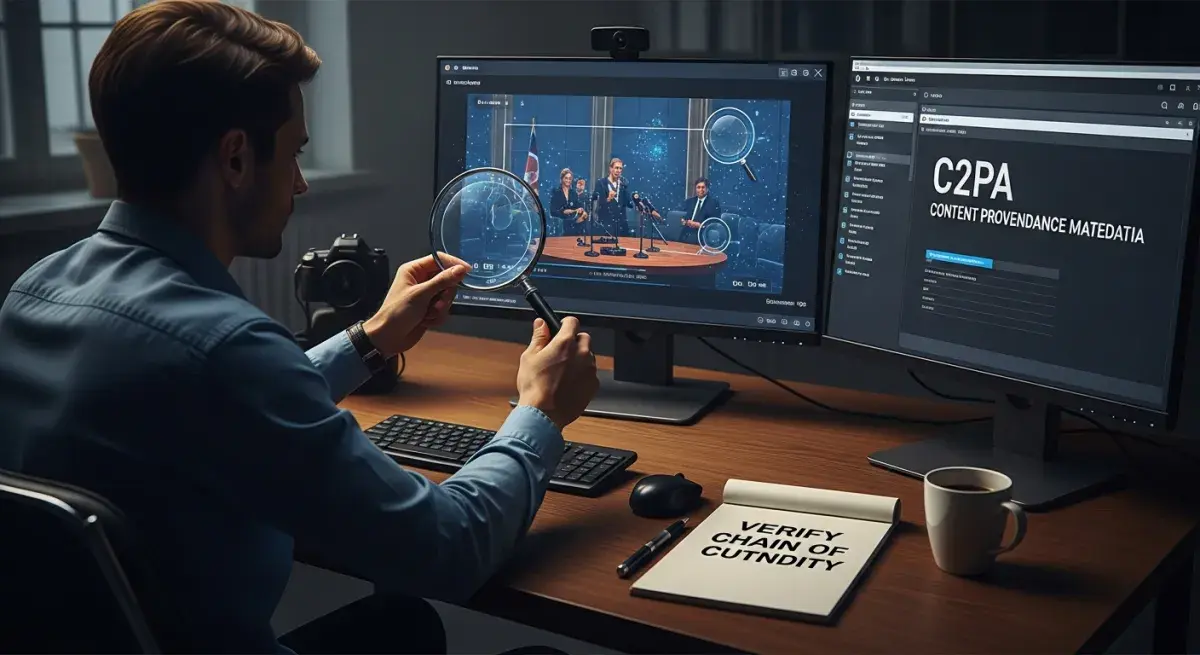
7. Provenance metadata: C2PA, SynthID, and Content Credentials
The Coalition for Content Provenance and Authenticity (C2PA) has been pushing a content credentials standard since 2021. As of 2026, adoption is meaningfully expanded but still partial. Adobe, Microsoft, Sony, Canon, Nikon, Leica, and a growing list of camera manufacturers embed C2PA metadata in captured content. Google's SynthID watermarks AI-generated images and video from Google's models. OpenAI watermarks Sora 2 output, though the watermark can be stripped. If a video carries valid C2PA metadata indicating an authentic capture device, that is a strong positive signal. If a video lacks any metadata, that is neutral (could be a legitimate re-encode or a deepfake). If a video shows a SynthID watermark on inspection, it is AI-generated.
Three Detection Tactics That No Longer Work in 2026
Counting fingers and watching for hand glitches in single frames
The 'AI gets hands wrong' meme is from 2022-2023. Sora 2, Veo 3, and Stable Video 3 render hands correctly in single frames the overwhelming majority of the time. The remaining errors are in multi-second hand-to-object interactions (see tactic 6 above), not in static frame anatomy. Do not rely on freeze-framing for finger counts.
Looking for blurry or warped earrings, glasses, jewelry
Earrings, glasses frames, watches, and small jewelry items were diagnostic for 2023-generation video models because they tended to warp or drift between frames. Frontier 2026 models render these objects with stable geometry over the entire clip duration. The detection signal is largely gone.
Background warping during camera motion
2022-2024 video models would produce background scenes that subtly warped, melted, or shifted geometry as the camera moved. Buildings would shimmer, foliage would flow unnaturally, distant cars would reshape themselves. Frontier 2026 models render coherent background geometry under camera motion. The signal still exists in very complex scenes (dense urban environments, crowds), but it is no longer reliable for simpler scenes.
The Working Verification Workflow for News Consumers in 2026
When you encounter a striking video that you might share or that might influence your beliefs, run this checklist in roughly two minutes:
- Trace the source. Click through to the original posting account. Verified? Public posting history matching the topic? Or anonymous account created recently?
- Search for corroborating coverage. Google News and the major outlets' websites for the event. If a significant event, expect multiple independent sources within an hour.
- Reverse-image-search 2-3 key frames. Yandex Images first, then Google Images, then TinEye. Match against real coverage or reveal source images the AI model referenced.
- Check environmental context. Weather, time of day, signage language, architectural details against what you know about the claimed location and timing.
- Watch hands and lips on close inspection. Multi-second hand sequences and lip-sync micro-mismatches still leak signal in 2026.
- Check for C2PA / Content Credentials metadata using contentcredentials.org's verifier tool if the platform exposes the metadata.
This workflow takes 90-120 seconds for an experienced user and catches roughly 85-90% of current-generation deepfakes. It is not foolproof. The April 2026 incidents proved that highly motivated bad actors can produce deepfakes that pass casual inspection on all the above tests — but they still fail source verification and corroboration tests, because a fake event cannot generate independent corroborating footage.
The Tooling Side: What Automated Detectors Can and Cannot Do
Automated deepfake detection is a $200M industry in 2026, with major investments from Microsoft (Video Authenticator), Intel (FakeCatcher), Reality Defender, Deeptrace Labs, and Sensity AI. The tools work — with significant caveats. Best-in-class detectors achieve 85-95% accuracy on the model generation they were trained against, but accuracy drops to 60-75% on the next generation of models that did not exist when the detector was trained. The detection community is permanently 6-12 months behind the generation community, and the gap is structural rather than temporary.
What this means in practice: automated detectors are useful as a confidence check, not a final verdict. If a detector flags a video as AI-generated, that is meaningful evidence. If a detector clears a video as authentic, that is weaker evidence than it sounds — the detector may simply not recognize the model that generated it. Treat detector results as one signal among the seven above, not as definitive.
The C2PA Provenance Rollout: Why This Problem Might Get Better
The longer-term solution is content provenance: cryptographically signed metadata attached at the point of capture, surviving through re-encodes and platform uploads, allowing viewers to verify that a video came from a specific camera at a specific time. The C2PA standard exists. Adobe, Microsoft, Truepic, Leica, Sony, Canon, and Nikon all participate. The remaining problem is consumer-platform adoption: TikTok, Instagram, YouTube, and Twitter/X have all announced C2PA support roadmaps but rollout is incomplete as of mid-2026.
When provenance metadata is universal across major platforms — probably 2027-2028 — the problem will shift from 'detect AI video' to 'verify authentic video.' Videos without valid C2PA metadata will be treated as potentially synthetic by default, similar to how websites without HTTPS are treated as untrusted by default in 2026. The deepfake detection problem does not disappear, but the burden of proof inverts. Until then, the seven tactics above are the working toolkit.
The Bottom Line
The April 2026 deepfake incidents were not a one-off. They were the first visible manifestation of a permanent change in the information environment. The seven detection tactics in this guide work as of mid-2026, but the underlying technology will continue to improve, and some of these tactics will erode within the next 12-24 months. Source verification, corroboration, and provenance metadata are the most durable signals. Visual artifact detection is the least durable — expect it to fail progressively as models improve.
For more on the broader trend of synthetic media going mainstream, see our coverage of the May 2026 AI video TikTok wave and the 'AI slop' phenomenon. For the science behind why detection is hard, the related piece on AI video going mainstream walks through the model architecture changes.
Origin
The April 2026 cluster of viral deepfake incidents — four AI-generated fake videos circulating on Twitter/X, TikTok, and Instagram with tens of millions of views before debunking — has driven a sharp spike in searches for 'how to spot AI video,' 'is this video real,' 'deepfake detection 2026,' and related variants. The previous standard advice (count fingers, watch earrings, look for warped backgrounds) was developed against 2022-2024 generation video models and no longer applies to Sora 2, Veo 3, Stable Video 3, and the current open-source frontier models. This guide synthesizes the working detection methodology from C2PA documentation, Microsoft Video Authenticator and Intel FakeCatcher technical papers, news coverage of the April 2026 incidents, and detection community discussion from venues like the Coalition for Content Provenance and Authenticity working group meetings.
Timeline
Why Is This Trending Now?
Search queries for 'how to spot deepfake,' 'is this AI generated,' 'deepfake detection,' and 'how to tell if video is real' have all risen 5-8x since mid-April 2026 per Google Trends, driven primarily by the four high-profile viral fake video incidents and by mainstream media coverage of the broader deepfake-detection arms race. The query patterns are dominated by ChatGPT and conversational-search formats ('how do I spot,' 'what are signs of,' 'is this video fake') rather than by traditional keyword search, reflecting the shift in user behavior toward conversational AI for evaluating uncertain information.
The trending angle is sharp because the topic combines high stakes (election interference, financial fraud, public safety) with concrete user agency (there are specific things readers can do to evaluate suspect videos themselves). This combination drives sustained search behavior far better than abstract 'AI is scary' coverage, and the practical-checklist format is what conversational-search engines tend to surface.